


Perhaps you’ve wondered, uncorking a bottle, where that name comes from: SanLorenzo. It’s not the name of a village, not a patron saint of the vine. It’s the name of a man. A man who spent his entire life chasing a single dream: to own a piece of land for himself.
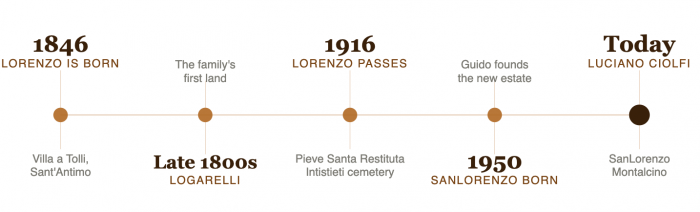
His name was Lorenzo Ferretti. He was born on January 28, 1846, to Pietro and Caterina, a peasant family at Villa a Tolli, a small hamlet nestled on the hills above Sant’Antimo, in that Montalcino countryside that still smells of wild herbs and warm stone today. He worked as a gamekeeper, but his thoughts were always elsewhere: on those fields that didn’t belong to him, held in the hands of a few bourgeois families who kept the land as a birthright.
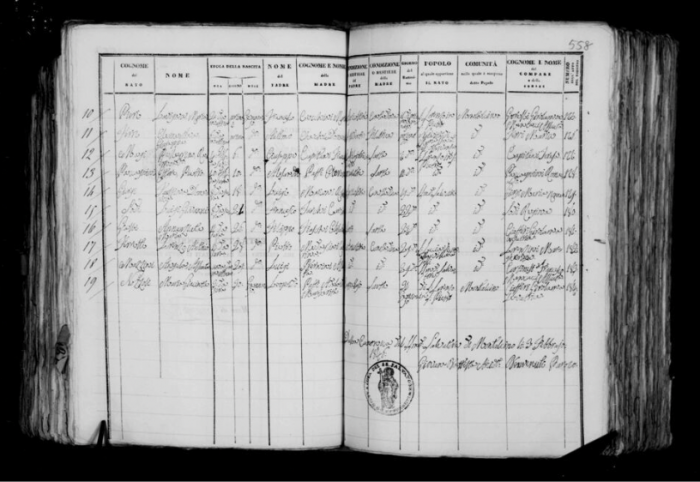
Below, a page from the handwritten birth register kept by the local municipality. Before 1875 — the year printed forms became standard across Italy — every record was written by hand by the civil registrar, line by line, in registers just like this one.
Lorenzo Ferretti married Carlotta, ten years his junior. Together they had six children, four girls and two boys: Guido and Settiminio, to whom Lorenzo would one day leave what he didn’t yet own, but already imagined.
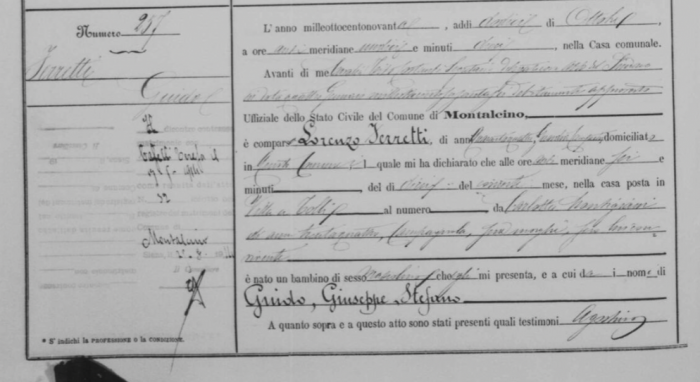
Below, a page from the pre-printed birth register introduced on January 1, 1875, when Royal Decree no. 2135 made standardised forms mandatory for all municipalities across Italy. Unlike the earlier handwritten registers, these new forms came with fixed columns and pre-set fields — name, date, parents, witnesses — leaving the civil registrar only to fill in the relevant details. Lorenzo’s signature appears here as proof that, unlike most peasants of his time, he could write.
At the end of the nineteenth century, he managed to buy a small plot of land called Logarelli. Bramante — nephew of Lorenzo and the grandfather of current owner Luciano Ciolfi — used to say that when Lorenzo first set foot on that land, there was nothing there but a shelter for pigs sent out to graze. Nothing more. But Lorenzo didn’t see poverty: he saw a starting point. Within a few years he built a house, and at the turn of the century the family moved there, onto that piece of hillside wrested from the world.
Lorenzo died in 1916, at the age of seventy. He is said to be buried in the cemetery of Pieve Santa Restituta — the one that was once called Intistieti. An ancient name, nearly forgotten, yet not truly gone: it became one of the most iconic wines of Montalcino. Carlotta also lived to seventy. Both were remarkably long-lived for their time.
At Rogarelli — as that land is still known today — the family grew and prospered. Children had children, the farm filled with voices and work. Until Guido, son of Lorenzo and father of Bramante and Giovanni, understood that it was time to break away. together with his wife Teresa. That estate had grown too small to hold all the dreams living inside it.
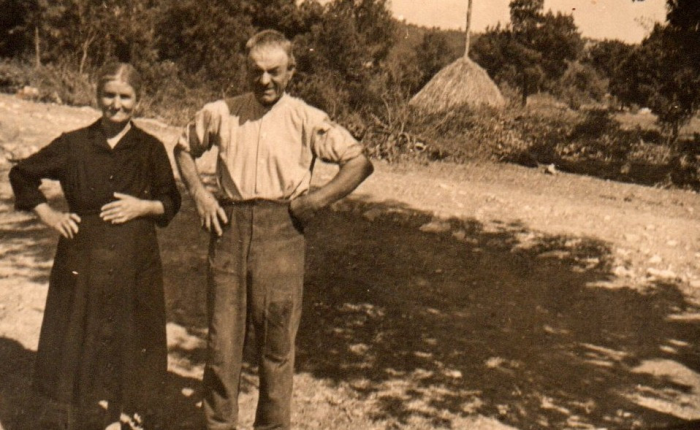
It was 1950. Guido and Giovanni took a portion of Rogarelli, bought an adjacent piece of land from the Argiano estate, and founded a new farm. They named it SanLorenzo, in honour of the grandfather who had started it all, who had claimed that land with his bare hands and the stubbornness of someone who has no other way.
Today, when you hold a bottle of SanLorenzo, you hold that story. Three generations of hands that have worked this land, and a name that has never changed: that of a farmer with an unyielding dream, born on January 28, 1846, on the hills above Sant’Antimo.
“When my grandfather Bramante told me about Lorenzo,
there was always a particular light in his eyes.
As if speaking of him was already a way of keeping him alive.
I hope this story does the same for you.” Luciano Ciolfi, 3rd generation.
You can read the story, but to truly understand it you have to come and live it. We look forward to welcoming you at SanLorenzo.
Luciano Ciolfi
SanLorenzo Montalcino
[/vc_column_text][/vc_column][/vc_row]
Perhaps you’ve wondered, uncorking a bottle, where that name comes from: SanLorenzo. It’s not the name of a village, not a patron saint of the vine. It’s the name of a man. A man who spent his entire life chasing a single dream: to own a piece of land for himself.
His name was Lorenzo Ferretti. He was born on January 28, 1846, to Pietro and Caterina, a peasant family at Villa a Tolli, a small hamlet nestled on the hills above Sant’Antimo, in that Montalcino countryside that still smells of wild herbs and warm stone today. He worked as a gamekeeper, but his thoughts were always elsewhere: on those fields that didn’t belong to him, held in the hands of a few bourgeois families who kept the land as a birthright.
Below, a page from the handwritten birth register kept by the local municipality. Before 1875 — the year printed forms became standard across Italy — every record was written by hand by the civil registrar, line by line, in registers just like this one.
Lorenzo Ferretti married Carlotta, ten years his junior. Together they had six children, four girls and two boys: Guido and Settiminio, to whom Lorenzo would one day leave what he didn’t yet own, but already imagined.
Below, a page from the pre-printed birth register introduced on January 1, 1875, when Royal Decree no. 2135 made standardised forms mandatory for all municipalities across Italy. Unlike the earlier handwritten registers, these new forms came with fixed columns and pre-set fields — name, date, parents, witnesses — leaving the civil registrar only to fill in the relevant details. Lorenzo’s signature appears here as proof that, unlike most peasants of his time, he could write.
At the end of the nineteenth century, he managed to buy a small plot of land called Logarelli. Bramante — nephew of Lorenzo and the grandfather of current owner Luciano Ciolfi — used to say that when Lorenzo first set foot on that land, there was nothing there but a shelter for pigs sent out to graze. Nothing more. But Lorenzo didn’t see poverty: he saw a starting point. Within a few years he built a house, and at the turn of the century the family moved there, onto that piece of hillside wrested from the world.
Lorenzo died in 1916, at the age of seventy. He is said to be buried in the cemetery of Pieve Santa Restituta — the one that was once called Intistieti. An ancient name, nearly forgotten, yet not truly gone: it became one of the most iconic wines of Montalcino. Carlotta also lived to seventy. Both were remarkably long-lived for their time.
At Rogarelli — as that land is still known today — the family grew and prospered. Children had children, the farm filled with voices and work. Until Guido, son of Lorenzo and father of Bramante and Giovanni, understood that it was time to break away. together with his wife Teresa. That estate had grown too small to hold all the dreams living inside it.
It was 1950. Guido and Giovanni took a portion of Rogarelli, bought an adjacent piece of land from the Argiano estate, and founded a new farm. They named it SanLorenzo, in honour of the grandfather who had started it all, who had claimed that land with his bare hands and the stubbornness of someone who has no other way.
Today, when you hold a bottle of SanLorenzo, you hold that story. Three generations of hands that have worked this land, and a name that has never changed: that of a farmer with an unyielding dream, born on January 28, 1846, on the hills above Sant’Antimo.
“When my grandfather Bramante told me about Lorenzo,
there was always a particular light in his eyes.
As if speaking of him was already a way of keeping him alive.
I hope this story does the same for you.” Luciano Ciolfi, 3rd generation.
You can read the story, but to truly understand it you have to come and live it. We look forward to welcoming you at SanLorenzo.
Luciano Ciolfi
SanLorenzo Montalcino